TSA PreCheck vs. CLEAR: A Comprehensive Guide to Expediting Airport Security

For millions of Americans, navigating airport security has become an unavoidable, often stressful, prelude to any journey. Long lines, the repeated removal of shoes and electronics, and the general unpredictability of wait times can dampen even the most anticipated travel plans. Fortunately, two prominent programs, TSA PreCheck and CLEAR, have emerged as popular solutions, promising to streamline the security experience. But which one is right for you? This guide delves deep into both programs, offering a detailed checklist and critical decision criteria to help US travelers make an informed choice.
Understanding the Airport Security Landscape: The Need for Speed
Before dissecting each program, it’s essential to understand the modern airport security environment. Post-9/11, security protocols were significantly enhanced, leading to the creation of the Transportation Security Administration (TSA). While these measures are vital for national safety, they often translate into bottlenecks at checkpoints, especially during peak travel periods. The average wait time can vary wildly, from a swift five minutes to over an hour, depending on the airport, time of day, and current events. Programs like TSA PreCheck and CLEAR aim to mitigate these inefficiencies, offering travelers a dedicated, often faster, path through security.
TSA PreCheck: The Government-Backed Expedited Lane
TSA PreCheck is a trusted traveler program administered by the Transportation Security Administration itself. Its primary benefit is providing eligible travelers with an expedited security screening experience at participating U.S. airports. When you enroll in PreCheck, you are identified as a low-risk traveler, allowing you to pass through a dedicated security lane with fewer requirements.
Key Features of TSA PreCheck
- Keep Your Shoes On: No more fumbling with laces or walking barefoot on airport floors.
- Keep Liquids and Laptops in Bags: Standard 3-1-1 liquids rule still applies (containers must be 3.4 ounces or less, fit in one quart-sized bag), but they can remain in your carry-on. Laptops and other large electronics also stay in your bag.
- Light Outerwear Stays On: You typically don’t need to remove light jackets or sweaters.
- Fewer Scanners: Often, PreCheck lanes use walk-through metal detectors instead of advanced imaging technology (AIT) scanners.
- Available at Most Major US Airports: PreCheck is operational at over 200 airports with more than 80 airlines participating.
The Enrollment Process for TSA PreCheck
Enrolling in TSA PreCheck is a straightforward process, though it does require a bit of planning:
- Online Application: Begin by filling out an application online at the TSA PreCheck website. This collects basic personal information.
- Schedule an Appointment: After the online application, you’ll need to schedule an in-person appointment at one of the many enrollment centers across the country.
- In-Person Interview: During your appointment, you’ll provide fingerprints, present valid identification (such as a U.S. passport or a driver’s license and birth certificate), and undergo a brief background check.
- Fee Payment: The application fee is typically $78 for a five-year membership. This fee is non-refundable.
- Known Traveler Number (KTN): If approved, you’ll receive a Known Traveler Number (KTN) within a few weeks. You must add this KTN to your airline reservations each time you book a flight to ensure “TSA PreCheck” appears on your boarding pass.
Cost and Value Proposition of TSA PreCheck
The standard fee for TSA PreCheck is $78 for five years, which breaks down to about $15.60 per year. Many premium travel credit cards offer a statement credit that reimburses this fee, effectively making it free for cardholders. Given the significant time savings and reduced stress, many travelers find this to be an excellent value, especially those who fly frequently (more than 3-4 times a year).
CLEAR: The Biometric Identity Verification Service
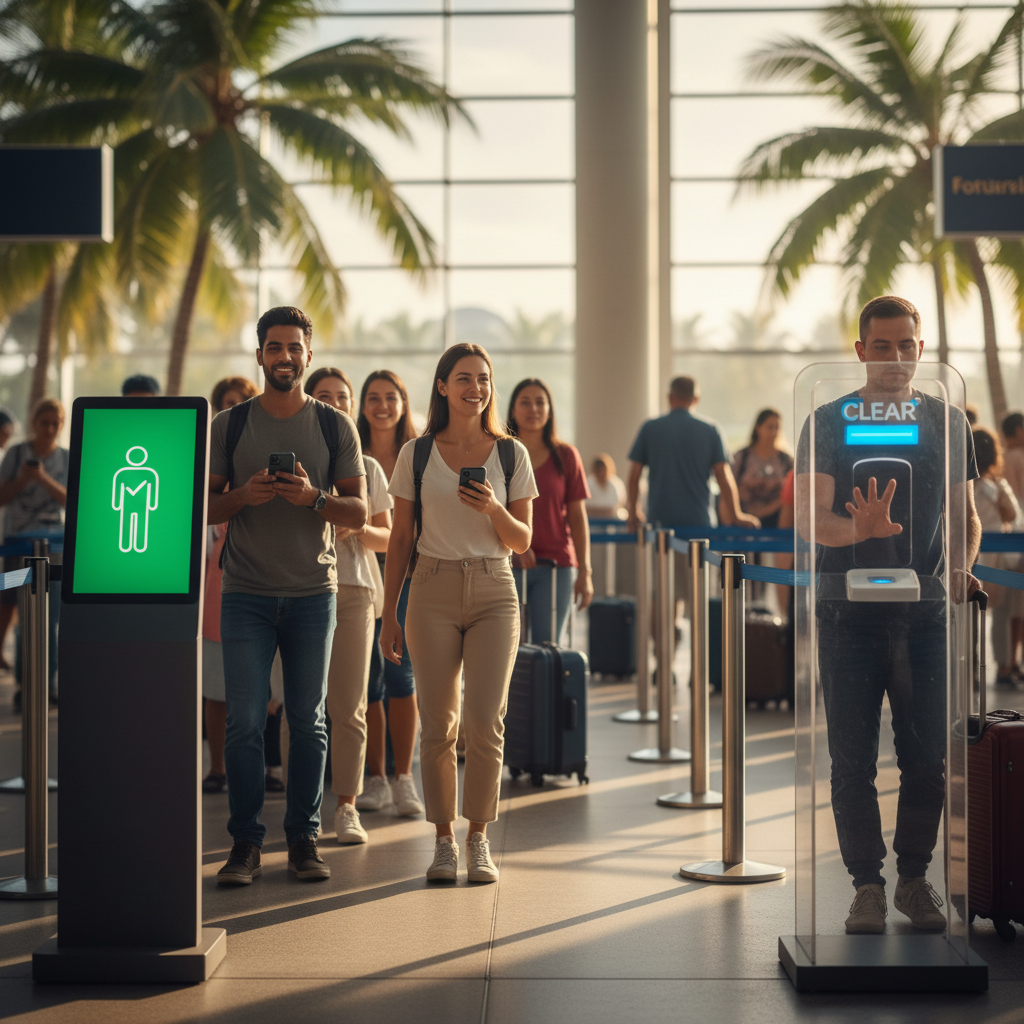
CLEAR takes a different approach to airport expediency. Instead of expediting the actual security screening process, CLEAR expedites the identity verification step before you even reach the TSA agent. It uses biometrics – your fingerprints or iris scans – to confirm your identity, allowing you to bypass the traditional document check line and proceed directly to either the standard security line or, more commonly and effectively, the TSA PreCheck line if you also have PreCheck.
Key Features of CLEAR
- Identity Verification Bypass: CLEAR members use dedicated lanes where their identity is verified almost instantly via biometrics, eliminating the need to present an ID to a TSA agent.
- Direct Path to Screening: Once verified, a CLEAR ambassador guides you to the front of the physical security line (either the standard line or the PreCheck line).
- Available at Major US Airports and Venues: CLEAR is expanding its footprint beyond airports to stadiums and other event venues, offering similar expedited entry benefits.
- Works with Standard and PreCheck Lanes: CLEAR complements PreCheck. While CLEAR gets you to the front of a line, PreCheck offers the relaxed screening rules within that line.
The Enrollment Process for CLEAR
Enrolling in CLEAR is also a multi-step process:
- Online Application: Start by completing an application online via the CLEAR website.
- In-Person Enrollment: You must complete the enrollment process at a CLEAR kiosk located at participating airports. There’s no need for a separate appointment; you can typically do it on the spot during your next trip.
- Biometric Scan: At the kiosk, a CLEAR ambassador will help you scan your fingerprints and/or iris for biometric identification. You will also need to present a valid photo ID (e.g., U.S. driver’s license, state ID, or U.S. passport).
- Fee Payment: The standard annual membership fee for CLEAR is $189.
Cost and Value Proposition of CLEAR
The annual fee for CLEAR is considerably higher at $189 per year. However, there are ways to reduce this cost:
- Airline Loyalty Programs: Members of certain airline loyalty programs (e.g., Delta SkyMiles Diamond, Platinum, Gold Medallion, and United MileagePlus Premier 1K, Platinum, Gold) often receive discounted rates or even complimentary memberships.
- Credit Card Benefits: Select premium credit cards, particularly those co-branded with airlines, may offer statement credits for CLEAR membership.
- Family Plan: You can add up to three adult family members to your CLEAR membership for an additional $99 per person per year. Children under 18 can use the CLEAR lane for free when accompanied by a CLEAR member.
The value of CLEAR is most pronounced for very frequent travelers, especially those who often face long lines at the initial ID check, even in PreCheck lanes. If you only fly a few times a year, the cost might be harder to justify unless you heavily utilize partner discounts or credit card benefits.
TSA PreCheck vs. CLEAR: A Side-by-Side Comparison Checklist
To aid in your decision-making, let’s compare these two programs directly across several key criteria:
Functionality: What Do They Speed Up?
- TSA PreCheck: Expedites the physical screening process (shoes, liquids, laptops stay on/in).
- CLEAR: Expedites the identity verification process (bypasses the ID check line).
Availability: Where Can You Use Them?
- TSA PreCheck: Over 200 airports nationwide with more than 80 participating airlines. Its presence is generally broad at any airport with TSA security checkpoints.
- CLEAR: Available at fewer, though often major, airports (around 50) and select sports stadiums/event venues. It requires dedicated CLEAR lanes.
Cost: What’s the Price Tag?
- TSA PreCheck: $78 for five years (approximately $15.60/year). Often reimbursed by travel credit cards.
- CLEAR: $189 annually. Discounts available through airline loyalty programs and some credit cards. Family add-ons at $99/person.
Enrollment Process: How Do You Sign Up?
- TSA PreCheck: Online application + in-person appointment for fingerprinting/interview. Requires valid ID.
- CLEAR: Online application + in-person enrollment at an airport kiosk for biometric scans. Requires valid ID.
Security Experience: What Changes?
- TSA PreCheck: Dedicated lane, shoes on, liquids/laptops in bags, light outerwear on.
- CLEAR: Dedicated lane to bypass ID check, then directed to the front of either standard or PreCheck security lines. Does not change screening requirements.
Dependence on Others: Can You Bring the Family?
- TSA PreCheck: Children 12 and under can accompany an adult with PreCheck in the PreCheck lane. Children 13 and older require their own PreCheck membership.
- CLEAR: Children under 18 can use the CLEAR lane for free when accompanied by an adult CLEAR member. Adult family members require their own (discounted) membership.
Decision Criteria: Which One is Right for You?
Choosing between TSA PreCheck and CLEAR, or deciding if you need both, depends heavily on your travel habits, budget, and priorities. Consider the following criteria:
1. Your Travel Frequency
- Infrequent Traveler (1-2 trips per year): TSA PreCheck might be a reasonable investment for the convenience, especially if a credit card covers the cost. CLEAR is likely overkill.
- Moderate Traveler (3-6 trips per year): TSA PreCheck is almost certainly worthwhile. CLEAR could be beneficial if you frequently travel through airports where CLEAR is available and often experience long wait times even in the PreCheck line.
- Frequent Traveler (7+ trips per year): Both programs could provide significant value. The combined benefits offer the fastest path through security.
2. Your Budget and Credit Card Benefits
- Cost-Conscious: TSA PreCheck is the more affordable option, and its cost is often covered by many popular travel credit cards (e.g., Chase Sapphire Reserve, Amex Platinum, Capital One Venture X).
- Premium Traveler: If you have a credit card that reimburses both TSA PreCheck/Global Entry and CLEAR, the decision becomes less about the direct cost and more about the added convenience. Always check your card benefits statement.
3. Your Local Airport and Common Destinations
- PreCheck Availability: If your primary airport and most frequent destinations do not have CLEAR lanes, then TSA PreCheck alone is the logical choice.
- CLEAR Availability: If you regularly fly out of and into airports that feature CLEAR, then it gains significant appeal. Check the CLEAR website for a list of participating locations.
4. Your Tolerance for Airport Stress
- Minimal Stress Tolerance: If any delay or queue causes you significant anxiety, then having both TSA PreCheck and CLEAR provides the ultimate peace of mind and speed. This combination virtually guarantees you’ll bypass most, if not all, major lines.
- Moderate Stress Tolerance: TSA PreCheck often provides enough relief for most travelers. The ability to keep shoes and laptops on/in bags significantly streamlines the process.
5. Family Travel Considerations
- Traveling with Young Children (under 13): TSA PreCheck is great as your young ones can join you in the expedited lane.
- Traveling with Teenagers (13-17): If you frequently travel with older children, consider that PreCheck requires them to have their own membership, while CLEAR allows them to join you for free. This can influence the total cost.
The Power of Combination: TSA PreCheck + CLEAR
For the ultimate expedited airport experience, many seasoned travelers opt for both TSA PreCheck and CLEAR. This “dynamic duo” combines the best of both worlds:
- You use CLEAR to skip the initial identity verification line. An ambassador guides you directly to the front of the security screening queue.
- Because you also have TSA PreCheck, you are then directed into the dedicated PreCheck lane, where you enjoy the benefits of not removing shoes, laptops, or liquids.
This combination effectively minimizes your time in line at two critical junctures of the airport security process. It’s often the fastest way from the terminal entrance to the airside concourse.
Important Considerations and Tips
- Global Entry: For international travelers, Global Entry is an even more comprehensive trusted traveler program. It includes TSA PreCheck benefits and expedites customs and immigration upon re-entry to the U.S. at no additional cost beyond the $100 application fee. If you travel internationally, Global Entry is generally a better investment than standalone PreCheck.
- Always Check Your Boarding Pass: Ensure “TSA PreCheck” is printed on your boarding pass. If it’s not, contact your airline or check your reservation before heading to the airport. Your KTN must be correctly added to your booking.
- Security is Not Guaranteed: While these programs significantly reduce wait times, they do not offer a 100% guarantee. Occasionally, TSA may conduct random additional screenings, and operational issues can affect any lane.
- Expiration Dates: Both programs have expiration dates. Set reminders to renew well in advance to avoid a lapse in benefits.
- No Change to Bag Rules: Neither program changes the rules regarding checked baggage or carry-on size and weight limits. These remain subject to individual airline policies.
Considerações Finais
The choice between TSA PreCheck and CLEAR, or opting for both, hinges on a personalized assessment of your travel habits, budget, and desire for efficiency. For most US travelers seeking a less stressful airport experience, TSA PreCheck offers an excellent balance of cost and benefit. For the ultra-frequent flyer or those who prioritize absolute minimal waiting at every step, combining PreCheck with CLEAR delivers unparalleled speed. By carefully reviewing your personal travel profile against the checklist and decision criteria provided, you can confidently select the program – or combination of programs – that best suits your needs and helps make your journeys smoother and more enjoyable.